

Pillar 1 · Education
Japanese Language Classes
From zero, in Hindi — to a job in Japan. Learn Japanese from ZERO with a Japanese teacher — taught in Hindi — and aim for the SSW (特定技能) visa.

NEW · FREE APP
MIRAI Japanese
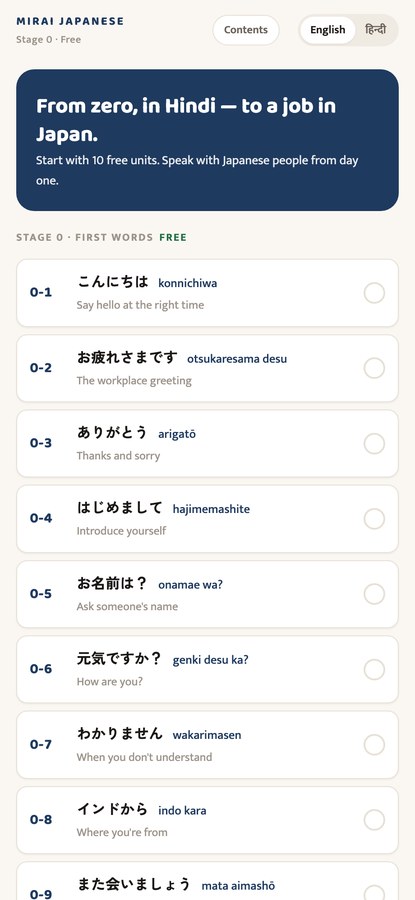
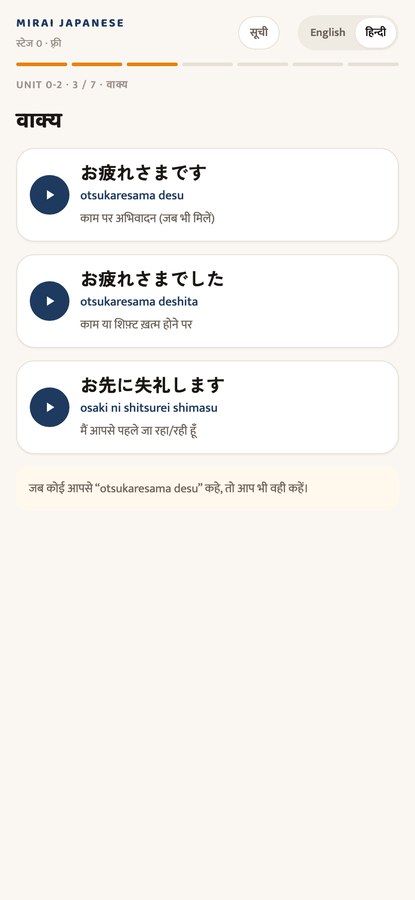
Japanese for working in Japan — from zero, explained in English and Hindi.
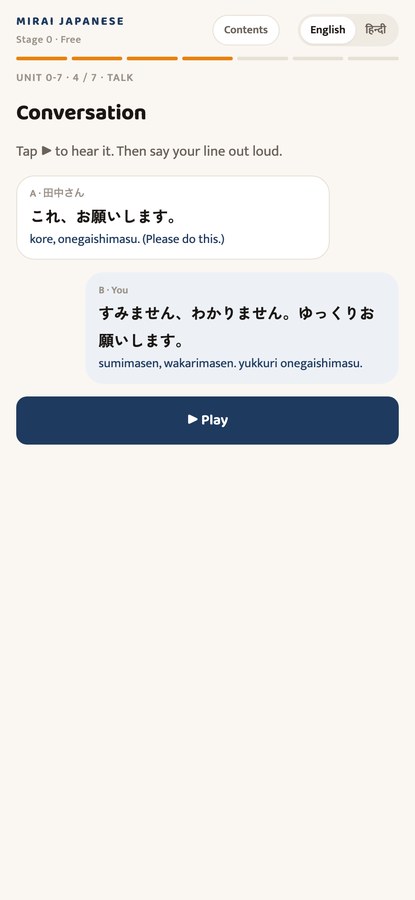
- Real Japanese audio for every phrase
- Workplace Japanese: greetings, safety, “I don't understand”
- Short 7-step units made for your phone
- The textbook for our upcoming online classes
Stage 0 (10 units) is free — no sign-up

At a glance
Course details
Planned schedule · live online group class, anywhere in India
First-year price · Pay in INR (UPI)
The exam Japan accepts for SSW
- Live online group classes — join from anywhere in India, with just a phone or laptop
- Taught in Hindi — every new word and grammar point is explained in your own language, so beginners never get lost
- Complete beginners welcome — we start from the very first hiragana
- Evening classes (after work hours), so people with jobs can join
- Taught by a Japanese teacher who explains in Hindi, in small groups
- Textbook: Irodori — the Japan Foundation's official book for the JFT-Basic exam, with Hindi support and audio
- AI conversation practice as homework — speak more, faster
- For SSW fields: Manufacturing, Caregiving, Construction and Agriculture
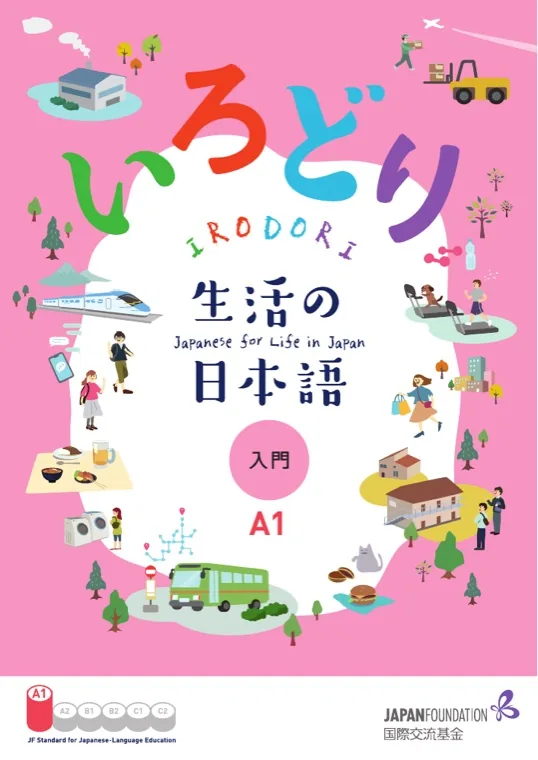
by the Japan Foundation
Money & how it works
Your questions about cost and the process, answered
Why is it only ₹3,000/month — and will it stay that price?
After the language class, what do I actually have to do next?
- Pass the JFT-Basic (A2) — the class is built to get you ready for it.
- Register for your field's official skills test — all four of our focus fields (Manufacturing, Caregiving, Construction, Agriculture) can be tested right here in India, no travel abroad needed.
- We introduce you to an employer — free, once both exams are passed (see the question below).
The skills test is a separate official step with its own fee — already counted in the exam-fee estimate below. It is not another paid class from us.
Are the JFT-Basic and the skills test the same exam?
No — they are two separate exams, and for SSW you need to pass both.
| JFT-Basic | Skills test | |
|---|---|---|
| What it tests | Your Japanese — A2 level: reading, listening, everyday conversation | The knowledge for your chosen job |
| Same for everyone? | Yes — one exam for every field | No — different for each field (e.g. Agriculture: crops or livestock, Caregiving, Construction) |
| Taken in India? | Yes | Yes, for all four of our focus fields |
| What we do | The class prepares you for it directly | We guide you on how to apply, the official study materials and how to prepare |
Who introduces me to a Japanese employer — and does that cost extra?
We do — free, as part of your journey with MIRAI. After you pass both the JFT-Basic and your skills test, your Japanese teacher personally:
- Finds the employer. Searches Japanese job sites — including the official sites that list SSW openings for test passers — for employers hiring in your field.
- Chooses your support organisation. From the Immigration Services Agency's official register of Registered Support Organisations (over 10,000 listed), to support you in Japan.
- Negotiates for you. Contacts the employer in Japanese, negotiates on your behalf, and explains your contract clearly in Hindi before you sign.
No debt to brokers, no placement fee.
Have you already sent students to work in Japan?
Not yet, and we want to be honest about that. MIRAI is a new school and our first batch is starting now. The Japanese classes are group classes.
After you pass both the JFT-Basic and your skills test, your Japanese teacher will personally support each student from this first batch through the next steps — employer interviews, preparation, and the COE and visa process.
What does it actually cost to reach Japan, in total?
The real numbers
What it costs — and what you can send home
What you pay (one-time)
- Exam fees₹6,000–8,000
- Passport & health check₹5,000–7,000
- Visa fee₹1,000–2,000
- Living costs until first salary₹30,000–50,000
Your flight to Japan is usually paid by the employer. No debt to brokers — you can reach Japan for your class fees, exam costs and a little pocket money.
In Japan (monthly example)
- Salary (gross)≈ ¥180,000 (₹100,000)
- After tax & insurance≈ ¥145,000 (₹81,000)
- Rent, food, phone≈ ¥75,000
- Left to save / send home≈ ¥70,000 (₹40,000)
Example only. Actual pay, deductions and living costs vary by field, region and employer, and exchange rates change. These figures are an illustration, not a guarantee.
Our class
Made for working beginners
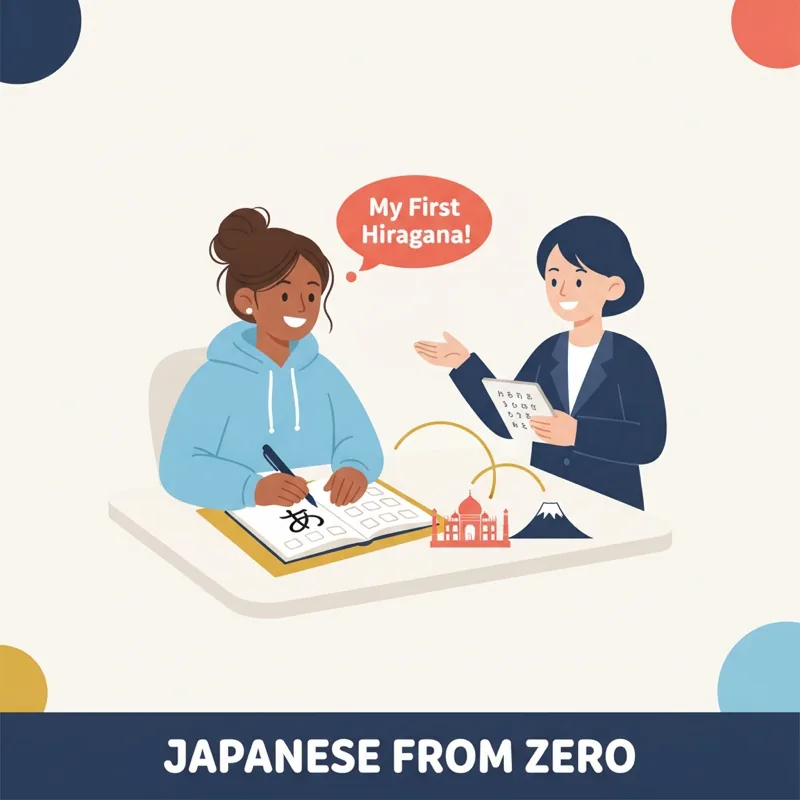
Beginners welcome
Start from the very first hiragana — no prior Japanese needed.
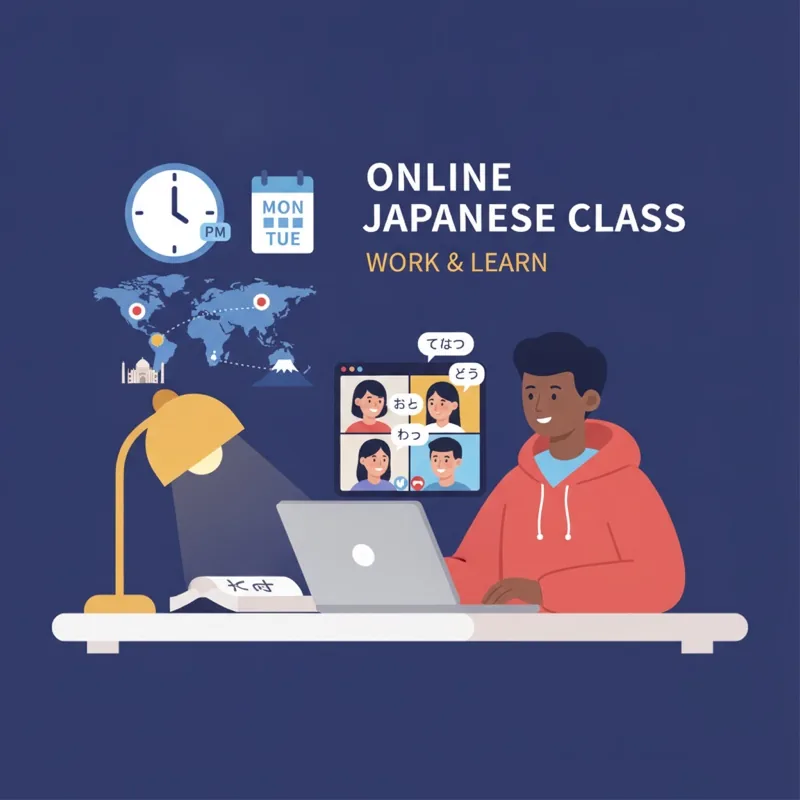
Evening, after work
Classes at 8–9 PM IST, so people with day jobs can join.

A Japanese teacher, in Hindi
Learn real, natural Japanese from a native teacher — who explains every step in Hindi.

Your teacher
Meet Yasuhiro
A Japanese teacher who has lived and worked across Japan, Nepal and India. He teaches real, natural Japanese — explained in Hindi — and knows exactly what Indian learners need to reach Japan.
Why Japan, why now
Japan needs you — this is the moment

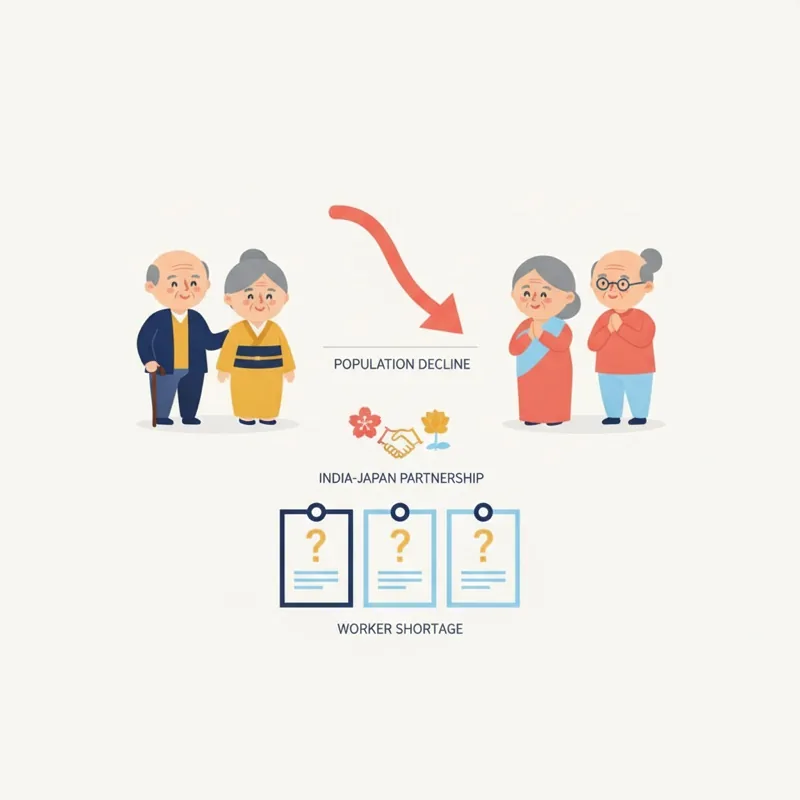
A country that needs workers
Japan's population is shrinking and ageing fast. It needs hundreds of thousands of workers from overseas — and now welcomes them legally and with open arms.
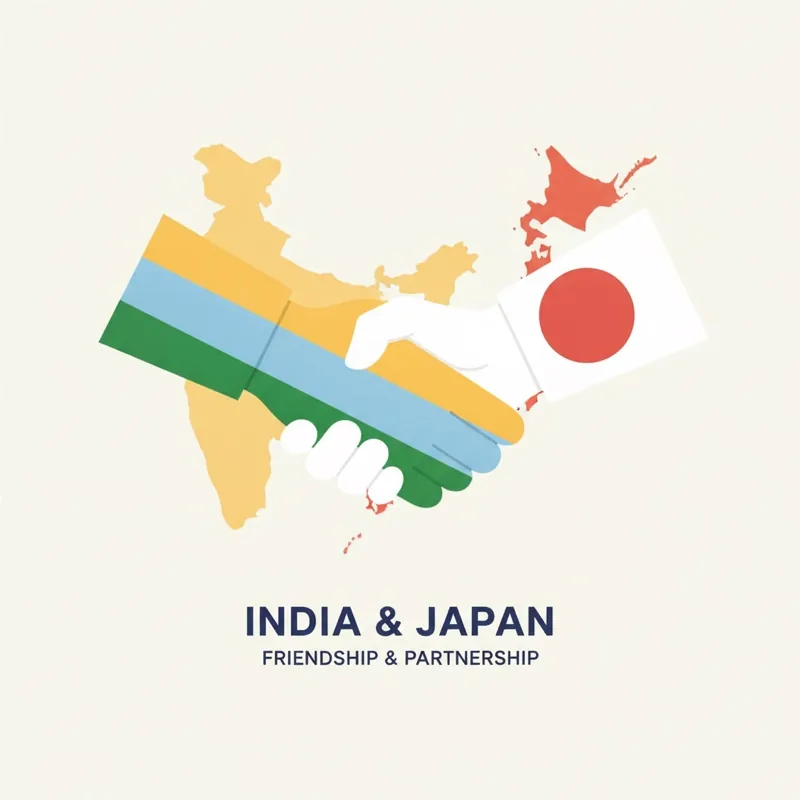
India ↔ Japan, by agreement
Under the 2025 India–Japan plan, the two governments aim to exchange over 500,000 people in five years — including 50,000 skilled workers from India to Japan.

Safe, clean, easy to live
The West may pay more and use English. But Japan is one of the safest, cleanest and most comfortable countries in the world — and a place where women feel secure.
What is SSW?
The SSW (特定技能) visa, explained
SSW — “Specified Skilled Worker” (特定技能) — is a Japanese work visa for foreign nationals in industries that need workers. It lets you live and work in Japan legally, with the same pay and conditions as Japanese workers.
The SSW visa covers 16 industry fields. The four in orange are where we focus — the best fit for Indian workers. Fields marked Paused are currently full and closed to new applicants.
Note on Food & Beverage Manufacturing (飲食料品製造業): its skills test is not held in India yet, so we don't feature it for now — availability can change, so ask us.
Which field is right for you?
Japan plans to accept up to 820,000 SSW workers in 2024–2029. We focus on four fields — manufacturing, caregiving, construction and agriculture — and every one of them can be tested right here in India. The 2025 India–Japan plan is making this pathway official, too (e-Migrate listing, NSDC cooperation).
Manufacturing 製造業
The largest intake of all SSW fields — a wide, steady door into Japan.
≈173,000 openings (2024–29)Caregiving 介護
Bring your family and aim for permanent residency. Indian caregivers grew 80%+ in a single year.
Family & permanent residencyConstruction 建設
Strong, lasting demand with a comparatively lower language barrier.
High demandAgriculture 農業
A great fit if you're from a farming area in West Bengal — familiar work and a lower language barrier.
≈78,000 openings (2024–28)Two things you need to qualify
- 1. A Japanese language test — JFT-Basic (A2) or JLPT N4. This is exactly what we train you for.
- 2. A skills test for your chosen field (caregiving, construction, and so on).
And you'll need Japanese not just to pass the test — but to live and work comfortably in Japan every day.
Stay 5 years — then bring your family
SSW Type 1 lets you work in Japan for up to 5 years. After that, by passing the Type 2 exam you can move to SSW Type 2 — which renews indefinitely, lets you bring your family, and opens a path toward permanent residency.
Who it's for
This class is for YOU!
Every SSW field is open to everyone, whatever your gender — these are just two example role models to help you picture your own path.
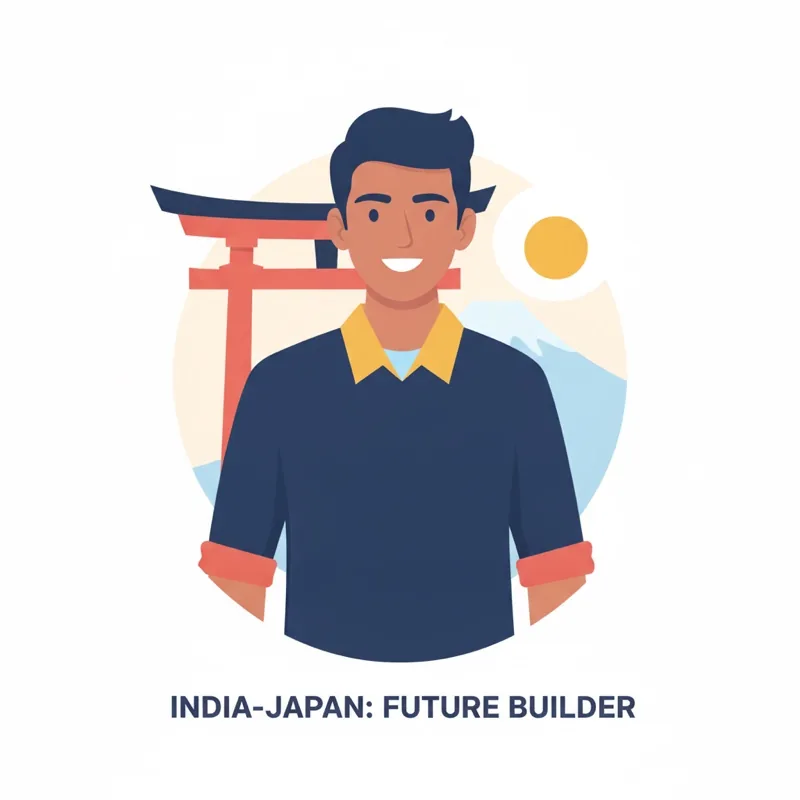
Rahul, 22 · Patna, Bihar
Your situationA Class 12 / ITI graduate in a low-paid local job. Hard-working and physically fit — and determined to change his family's life.
Best-fit fieldManufacturing, Construction or Agriculture
Your future in JapanA stable income, money to send home, and real skills for the future.
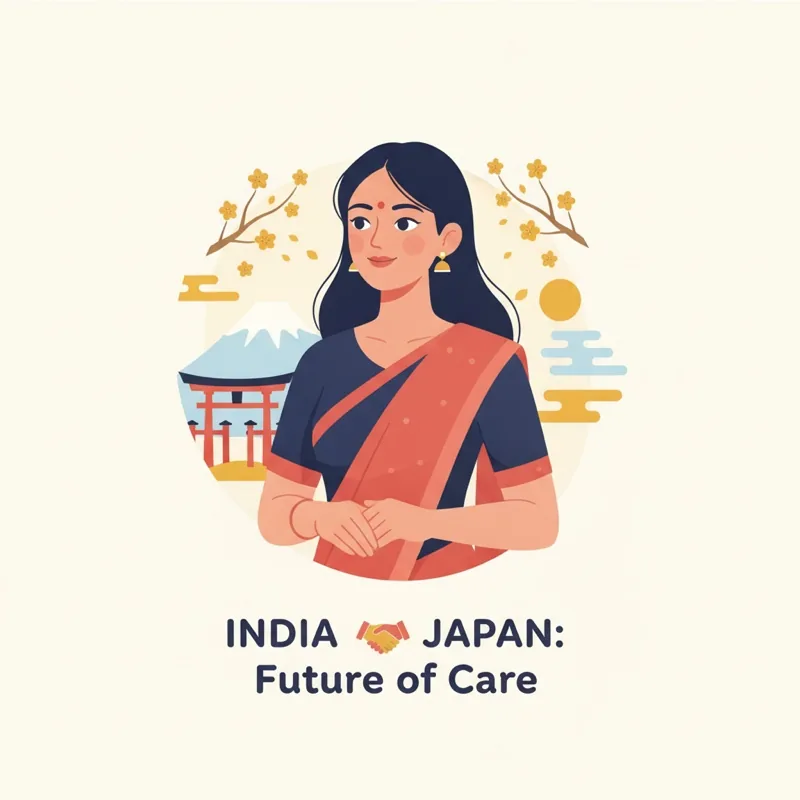
Priya, 24 · Lucknow, Uttar Pradesh
Your situationCaring and patient, drawn to work that helps people. She wants long-term stability and to bring her family in time.
Best-fit fieldCaregiving — your family can join you, with a path to permanent residency
Your future in JapanRespected work, a national qualification, and a long-term life in Japan.
Your journey
From zero to working in Japan
India
Start from zero
Learn & train
10 months · SSW skills
Visa & CoE
4–5 months
Japan
Start working
Start Japanese from zero
Join MIRAI's beginner class and learn step by step with a Japanese teacher.
Pass JFT-Basic (A2)
Reach the Japanese level Japan requires for the SSW visa.
Pass your skills test
Clear the skills test for your field — manufacturing, caregiving, construction or agriculture. All four are testable in India.
Match with a Japanese employer
Get introduced through a registered support organisation.
Get your SSW visa & fly to Japan
Start working — with the same pay and conditions as Japanese staff.
Grow your future
After up to 5 years, move to SSW Type 2, bring your family, and aim for permanent residency.
Curriculum
From zero to JFT-Basic in 10 months
2 trial classes
Meet the teacher, try a real lesson, and see how the course works.
Term 1 · Irodori Starter (A1)
Hiragana & katakana, then 18 topics covering greetings, self-introduction, daily life and work situations.
Term 2 · Irodori Elementary 1 (A2)
Build real conversation skills and more kanji, with everyday and workplace Japanese.
Term 3 · Elementary 2 + JFT-Basic prep
Reach A2 level and practise with JFT-Basic mock tests until you're exam-ready.
AI homework & self-study
AI conversation practice plus about 4 hours of guided self-study a week — so you reach the level much faster.

After you pass
From exam to Japan — about 4–5 months
Once you clear JFT-Basic and your skills test, we guide you all the way to the airport.
Online interview & job offer
We prepare your résumé, practise the interview with you, and join the call with the Japanese employer.
Contract & pre-departure guidance
We explain your employment contract clearly in Hindi or Bengali — so you know exactly what you're signing.
Certificate of Eligibility (CoE)
Japan reviews your paperwork. During this wait we keep you learning and ready — this is where many drop out, and where we stay with you.
Visa & flight
We support your visa application at the Kolkata consulate / VFS. Your one-way flight is usually paid by the employer.
Departure
We see you off at Kolkata airport — your new life in Japan begins.
Latest info
News & updates
Batch announcements, exam tips and student stories will appear here. Want to be notified? Message us on WhatsApp.